Showing posts with label graphic novel. Show all posts

Wednesday, December 7, 2011

Graphic Novel, my dear Watson

Recommended grades 9-12.  The illustrious consulting detective Sherlock Holmes is back in action, or graphic!  Adapted by author Ian Edginton and artist I.N.J. Culbard, A Study in Scarlet (Sterling, 2010) chronicles Sherlock Holmes's first adventure with his mild-mannered partner, Dr. Watson.  Culbard's illustrations take readers from colonial Afghanistan to Victorian London to frontier Utah.  Characters are drawn in pulp comic style, with particular detail on facial features-- Holmes has the strong chin of a Superman, while Watson bares the round nose of a lovable oaf.  Scenes in Mormon Utah are colored in sepia, fitting with the flashback narrative, while the rest is illustrated in rich, though dark, colors.  Culbard maintains most of Conan Doyle's original language- reminding readers that although the story has been adapted in comic form, it is not necessarily an easy read.  The dialog is peppered with advanced medical terms, Victorian dialect, and, of course, the quick wit of Sherlock Holmes.  The language in the book is definitely better for more advanced reading.  The graphic novel captures much of the original, and Holmes aficionados will be overjoyed that so much has been maintained.  Recommended, ***.

Friday, November 25, 2011

Jews in America

Recommended grades 10-12.  Illustrated histories are a great way for readers to access dense material.  In today's graphic novel market, there is an abundance of historical non fiction material.  Daniel Gantz contributes to this subgenre with Jews in America (The Jewish Publication Society, 2006).  Gantz covers a staggering amount of history in under 200 pages-- he traces Jews in diaspora starting in 1189 until Kofi Annan's 2005 speech about modern anti-semitism.  Though focused primarily on Jews living in America Gantz adds commentary about America's relationship with Jews outside the United States, primarily in Europe and Israel.  Gantz illustrates in dark sepia; his style mirrors political cartoonists like Thomas Nast.  Though told in "cartoon," Gantz's history is not watered down.  He uses a complex vocabulary and does not shy away from controversial topics. It is important to note that Gantz does not provide an entirely unbiased explanation of current events.  Gantz does a good job of creating a book about Jewish history not entirely shrouded in the horror of the Holocaust, which many library collections for young people lack.  Still, this volume would be best for more mature readers.  Additional Selection, ***.

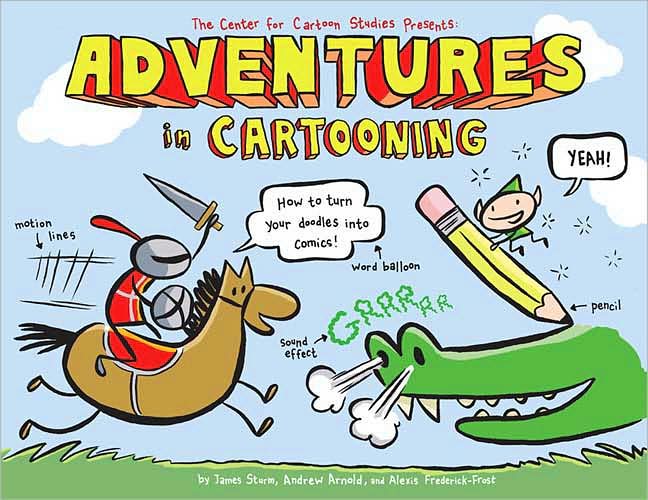
Adventures in Cartooning

Recommended grades 3-5.  Comic artists James Sturm, Andrew Arnold, and Alexis Frederick-Frost break down the art of comic-making in Adventures in Cartooning (First Second, 2009).  Sturm and company instruct on the form through the Magic Cartooning Elf, who accompanies a knight on a comic adventure to defeat a dragon.  Throughout, the Elf plays with aspects of comics, including panels, speech bubbles, and ways to express emotion through drawings.  The illustrations are simple enough for children to imitate (there are even step-by-step directions at the end), though the coloring adds shade and depth.  The artists behind the book clearly care a lot about demystifying comics and encourage readers to use the lessons learned to create their own stories.  Excellent for students who are interested in art and comic books, and even those who aren't will enjoy the fun characters and creative story-telling.  Highly recommended, *****.

Tuesday, September 20, 2011

James Sturm's America

Grades 9-12 Graphic novelist James Sturm takes us through an outsider's journey in American history in James Sturm's America: God, Gold, and Golems.  This history is told in three main sections, the first a family making a wagon-covered journey to a Christian revivalist meeting during the Second Great Awakening, the second follows a rag tag group of miners in a squalid mining camp wrought with violence, and finally, we find a (mostly) Jewish minor-league baseball team eking out a living by heightening their strangeness to rural America.  Though at times requiring a mature reader with background knowledge, this history is wonderful in that it tells lesser-known narratives in a compassionate and reader-friendly way.  The reader can sympathize with a family torn apart by the migratory forces in America, Chinese American miners denied their basic rights, and Jewish Americans (far away, for once, from the legacy of the Holocaust) encountering small American towns with myths as thick as German hamlets.  The illustrations and shading are gripping, and text clear and easy to read.  Done entirely in black and white inking, Sturm beautifully captures raw emotion with his figures, as well as depicting historical scenes and characters in an attractive, though sometimes haunting, and engaging way.  This is a history of outsiders, and a great addition to a graphic novel collection.  Recommended ****