Recommended grades 6-8. Steven Shenkin loves Benedict Arnold, and he wants readers to share his appreciation. Shenkin pulls together years of research into a narrative of Benedict Arnolds tumultuous years on both sides of the Revolutionary War. Shenkin paints a conflicted Arnold, desperate for acknowledgement (and payment) for his heroics. Shenkin draws quotes from primary sources, and provides an extensive reference list at the back of the book. The narrative Shenkin creates is engaging, and he provides vintage-looking maps to illustrate the major battles Arnold participated in. This book will teach young adults (and adults alike!) to appreciate the sometimes flawed heros that fill history books. The narrative could have been improved with an insight into Shenkin's process, tough overall an excellent book, well worth the recognition it has received.
Recommended, ***
Showing posts with label history. Show all posts
Tuesday, February 7, 2012
Tuesday, December 13, 2011
The Anne Frank Case
Recommended grades 4-8. Susan Goldman Rubin shares a biography of Simon Wiesenthal, the 'Nazi hunter,' on his quest to find the man who arrested Anne Frank and family in their Amsterdam hideaway. The story begins after World War II as Wiesenthal, a Holocaust survivor, is confronted by postwar Neo-Nazis and Holocaust denial. Though a mature subject, Rubin manages to explain the Holocaust and neo-Nazism in a remarkably clear way. The book explores Wiesenthal's own experience in concentration camps, and explains his unrelenting drive to find former Nazis and to bring them to trial. Illustrator Bill Barsworth contributes dark paintings of Wiesenthal, the Holocaust violence, and the afterwar period. Some of the images in are chilling in their detail; one portrait of Anne Frank, with warm eyes looking off in the distance as she sits writing in her diary, is particularly haunting. The biography is clearly well-researched; Rubin includes detailed source notes, photographs of Wiesenthal, and a glossary for readers new to the subject. Though a beautiful picture book, it is definitely meant for mature readers. This could be a wonderful addition for classes studying the Holocaust using longer narratives, like Number the Stars, or the Diary of Anne Frank itself. Overall, an incredible story, definitely one worth passing down and including in any class study of the Holocaust. Highly recommended, *****.
Friday, November 25, 2011
Jews in America
Recommended grades 10-12. Illustrated histories are a great way for readers to access dense material. In today's graphic novel market, there is an abundance of historical non fiction material. Daniel Gantz contributes to this subgenre with Jews in America (The Jewish Publication Society, 2006). Gantz covers a staggering amount of history in under 200 pages-- he traces Jews in diaspora starting in 1189 until Kofi Annan's 2005 speech about modern anti-semitism. Though focused primarily on Jews living in America Gantz adds commentary about America's relationship with Jews outside the United States, primarily in Europe and Israel. Gantz illustrates in dark sepia; his style mirrors political cartoonists like Thomas Nast. Though told in "cartoon," Gantz's history is not watered down. He uses a complex vocabulary and does not shy away from controversial topics. It is important to note that Gantz does not provide an entirely unbiased explanation of current events. Gantz does a good job of creating a book about Jewish history not entirely shrouded in the horror of the Holocaust, which many library collections for young people lack. Still, this volume would be best for more mature readers. Additional Selection, ***.
Labels:
***,
America,
Europe,
graphic novel,
high school,
history,
Israel,
Jewish,
non fiction,
political
Monday, November 21, 2011
A Doll's Life
Recommended grades 7-10. Tanya Lee Stone dives into the life of American Sweetheart, Barbie with her unauthorized 'biography, ' The Good, the Bad, and the Barbie: A Doll's History and Her Impact on Us (Viking, 2011). Stone covers a variety of aspects about the doll everyone loves to hate and hates to love, from the story of her creator, Ruth Handler, to her own development in the last fifty years. Stone also approaches many of the criticisms Barbie has faced over the years, from her impossible-to-achieve figure, to her Euro-centric hair texture, Stone does not shy away from controversy. Stone makes her voice quite clear as a researcher, openly explains her interpretations of her sources, and offers the final decision up to her readers; is Barbie to blame for anorexia or to celebrate for encouraging professional women? In addition to her open tone, Stone includes a detailed list of source notes at the end of the text as well has a brimming bibliography. The book is filled with black and white photos illustrating Stone's many points and showing Barbie over time. Additionally, Stone includes a color insert of photos that benefit from full color. This book is not only informative, it also serves as an excellent conversation starter and a model of good research. Highly recommended, ****.
Thursday, November 10, 2011
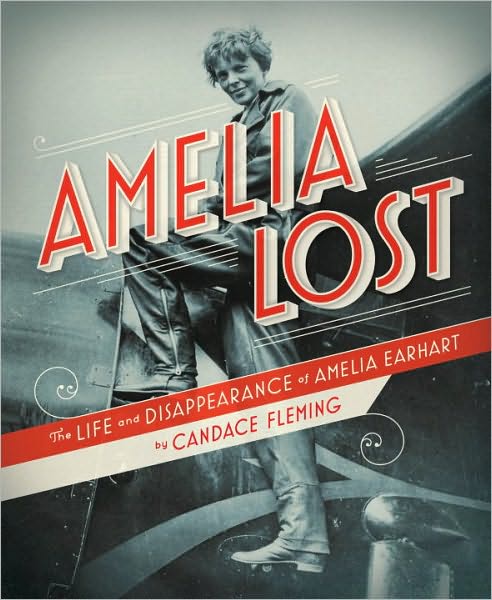
Amelia Lost
Recommended Grades 6-9. Candace Fleming brings us an eloquent and compassionate biography with Amelia Lost: The Life and Disappearance of Amelia Earhart (Schwartz & Wade, 2011). Narration of the infamous female aviator's life is broken up with small vignettes accounting her fateful crash on July 5, 1937. Though the reader begins the story knowing what will happen, their heart will beat anyway with the beautifully executed narrative flow. Meticulously researched and well-rounded, Fleming offers many perspectives and allows readers to question common myths about Amelia. Fleming models historical best practice by openly analyzing her sources and questioning their intent for readers to consider. She includes an in-depth bibliography and suggestions for further research. The narrative is also broken up with contextual asides, which serve to inform the reader of technologies that existed in Amelia's time; from the planes she flew to the radio system that was ultimately her downfall. Along with these contextual asides, Fleming includes captioned photographs of Amelia and the world she lived in--including an interesting look at advertising--so that readers can better understand the influences that surrounded Earhart. A new Amelia comes to light through Fleming's telling, and readers will walk away with a broader understanding of Amelia in her context. Highly recommended, *****.
Monday, October 10, 2011
For the Love of Music
Thursday, September 29, 2011
Bloody Jack
Grades 6-8. In L.A. Meyer's novel, Bloody Jack (Harcourt, 2004), Mary "Jacky" Faber transforms herself into Bloody Jack Faber to escape her life in Dickensian London. Orphaned on "The Dark Day" her parents were killed by "pestilence," young Mary survives on the streets, scrounging just enough to get by. In search of a better life, Mary disguises herself as a boy and seeks out a job as a ship's boy on a naval vessel on its way to South America after French pirates. All Mary is looking for is a square meal and a roof over her head, but she winds up with a lot more. Part Treasure Island, part Twelfth Night, and a dash of Are You There God? It's Me, Margaret, Jacky faces not only pirates and scalawags, but also her first period. At times Jacky's narrative in 'mockney' is a little cumbersome, and may be challenging for some readers, but at it's best it adds playfulness to the character. Full of fun and adventure, this book also alludes to very some very adult themes. Overall, Mary "Jacky" Faber will appeal to both boys and girls, just as she is able to slip between the genders with artful costumes. And if you can't get enough of this saucy, sea-faring lass, she continues her adventures in a series of eight further books (so far!). Recommended, ***
Thursday, September 22, 2011
Chains
Grades 6-8. Laurie Halse Anderson tells a different sort of coming-of-age story with her novel Chains (Athenium, 2008).
Anderson follows Isabel, a young slave born with a kind and liberal master in Rhode Island but sold to cruel New York Loyalists at the height of America's War of Independence. Through Isabel, Anderson explores the ambiguity of "freedom" on both sides of the war; she encounters Patriots who cry for freedom but are not willing to treat slaves as anything other than property, and Loyalists willing to free slaves, but only for the sake of harming the Patriot's cause. Anderson's historical fiction is meticulously researched, she includes quotes from primary documents thematically as the header of each chapter and has a well cited list of historical questions in her final author's note. History teachers will appreciate the possibility to use this book as a teaching tool both in content and in method. Anderson offers a unique slave tale far away from the normal Civil War story and paints a complicated and rich story of American ideology that should raise stimulating questions in advanced readers minds. Highly Recommended, *****
Labels:
*****,
America,
citation,
coming-of-age,
George Washington,
historical fiction,
history,
Laurie Halse Anderson,
Loyalist,
middle school,
New York,
Patriot,
primary sources,
research,
Revolutionary War,
slavery
Tuesday, September 20, 2011
James Sturm's America
Grades 9-12 Graphic novelist James Sturm takes us through an outsider's journey in American history in James Sturm's America: God, Gold, and Golems. This history is told in three main sections, the first a family making a wagon-covered journey to a Christian revivalist meeting during the Second Great Awakening, the second follows a rag tag group of miners in a squalid mining camp wrought with violence, and finally, we find a (mostly) Jewish minor-league baseball team eking out a living by heightening their strangeness to rural America. Though at times requiring a mature reader with background knowledge, this history is wonderful in that it tells lesser-known narratives in a compassionate and reader-friendly way. The reader can sympathize with a family torn apart by the migratory forces in America, Chinese American miners denied their basic rights, and Jewish Americans (far away, for once, from the legacy of the Holocaust) encountering small American towns with myths as thick as German hamlets. The illustrations and shading are gripping, and text clear and easy to read. Done entirely in black and white inking, Sturm beautifully captures raw emotion with his figures, as well as depicting historical scenes and characters in an attractive, though sometimes haunting, and engaging way. This is a history of outsiders, and a great addition to a graphic novel collection. Recommended ****
Subscribe to:
Posts (Atom)