Showing posts with label elementary. Show all posts
Monday, December 12, 2011
Bananagrams
Recommended grades 3 and up. Bananagrams (costs around $15.00) can be described simply as competitive, speed, solitaire Scrabble. Players receive individual tiles and create their own connecting words. The first user to use all of their tiles after several rounds wins. Because players are in charge of their own words, the game works at any level; third graders can play within their working vocabulary, while seniors in high school can play within theirs. Younger players may need more oversight and guidance in playing the game. One drawback is the little pieces, which can easily be lost, but the game can still be played with a few missing letters. This is an excellent pick-up game that does not require much set-up and easily adapts itself to any players. Educational, friendly, and competitive, this game will make an excellent edition to a board game collection. Highly recommended, *****.
Sunday, November 27, 2011
The Goddess of YA Literature
Review Blog. Teri Lesesne, aka the Goddess of YA Literature, blogs book reviews daily from Sam Houston State College where she serves as a professor in Library Science. The Goddess reviews mostly for younger readers- picture books and early chapter books fill most of her posts, though she also makes room for middle chapter books. Her reviews often run no more than five sentences, and often are two or three. Most reviews are made of a single sentence of summary, and one or two sentences of glowing review. The Goddess seems to adore every book she encounters, which is not necessarily a bad thing but at times she seems like the little librarian who cried "excellent!" One excellent feature of her blog is her grouping of books within themes. This would be of great use to teachers and librarians for quick story time picks. She also makes great use of a tagging system which facilitates easy navigation of seven year's worth of daily reviews. This is a good blog to review for quick picks, but do not expect a critical understanding of contemporary books. Additional selection, **
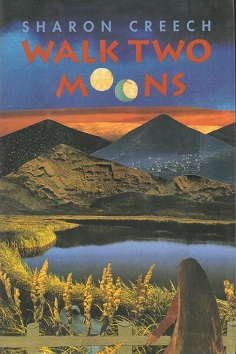
Walk Two Moons
Recommended grades 4-6. Salamanca Tree Hiddle has heard the American Indian proverb, "Don't judge a man until you've walked two moons in his moccasins," so she, along with her grandma and grandpa, are walking in the moccasins of her mother, who left their family in their home of Bybanks of Kentucky and took a bus to Idaho. Along the way, Salamanca shares the story of her friend, Phoebe, another girl left behind with no mother. Walk Two Moons (Scholastic, 1994), is a story of friendship, forgiveness, and above all, family. Sharon Creech brings to life an incredible cast of unforgettable characters; from Gram & Gramps Hiddle, who married because Gramps treated his beagle well, to Phoebe who frets about cholesterol and lunatics, and of course, Salamanca, who kisses trees to taste blackberries and find her mother's love. Walk Two Moons is, and will remain, a timeless classic well worth its Newberry Medal and it's permanent place in library collections. Highly recommended, *****.
Saturday, November 26, 2011
Whole Story of Half a Girl
Recommended grades 5-7. Sonia Nadhamuni is a girl of the 21st century-- half Indian, half Jewish, and completely conflicted. The Whole Story of Half a Girl (Delacourt Books, 2012) is an excellent updated companion to Judy Bloom's Are You There God? It's Me, Margaret. Like Margaret, Sonia inhabits the grey area between her parents' cultures. When her father loses his job, Sonia must leave the comfort of her progressive private school to face public school. There she is forced to choose a racial identify-- should she join the perky blond cheerleaders or align herself with the African-American students bussed from other neighborhoods? Sonia is neither blond nor black, and is frustrated at having to identify as Jewish because her family is not religion. Sonia faces the question that many young people face today-- with an over abundance of cultures, how can you pick and choose which to identify with? Author Veera Hiranandani gives Sonia an eloquent and empathetic voice, and addresses sensitive issues with grace. In addition to race and religion, Sonia reckons with her father's chronic depression, which tears him away from the family. Overall an excellent, entertaining, intellectually stimulating YA novel that would complement any library collection. Highly recommended, ****.
Friday, November 25, 2011
Adventures in Cartooning
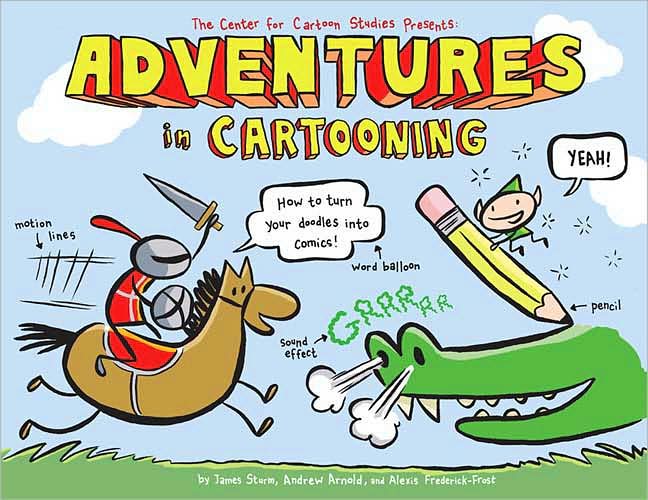
Recommended grades 3-5. Comic artists James Sturm, Andrew Arnold, and Alexis Frederick-Frost break down the art of comic-making in Adventures in Cartooning (First Second, 2009). Sturm and company instruct on the form through the Magic Cartooning Elf, who accompanies a knight on a comic adventure to defeat a dragon. Throughout, the Elf plays with aspects of comics, including panels, speech bubbles, and ways to express emotion through drawings. The illustrations are simple enough for children to imitate (there are even step-by-step directions at the end), though the coloring adds shade and depth. The artists behind the book clearly care a lot about demystifying comics and encourage readers to use the lessons learned to create their own stories. Excellent for students who are interested in art and comic books, and even those who aren't will enjoy the fun characters and creative story-telling. Highly recommended, *****.
Labels:
****,
art,
comic book,
elementary,
fantasy,
graphic novel,
how-to,
knight,
magic,
strong heroine
Sunday, November 13, 2011
Retro Mystery- American Girl Style
Recommended grades 4-6. The American Girls have gone far out with Julie, a girl living in San Francisco during the groovy 1960's and 70's. In The Secret Guitar (American Girl Publishing, 2011), part of the Julie Mystery Series, Julie and her friends must find a stolen guitar that belonged to (fictional) rock star, Danny Kendricks. The guitar is part of a charity auction for a recent oil spill in the San Francisco Bay that is devastating the marine life. Author Kathryn Reiss drew her inspiration from her own childhood, though as a piece of historical fiction, it is unconvincing. Reiss creates fictional versions of people and events (Jimi Hendrix, the Exxon oil spill) instead of using their real life counterparts. This is confusing, and ultimately doesn't achieve what great historical fiction should do- teach readers about actual historical time periods using a combination of fact and fiction. Reiss's words capture feeling and fiction, and she includes a quick historical afterword connecting the story to history. Ultimately, the story would have been much more valuable to readers had she written within the true 1960s instead of creating a fictional parallel. Additional Selection, **
Sunday, October 30, 2011
Rainbow Magic
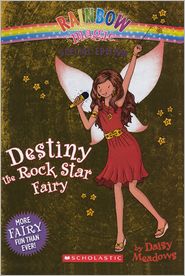
Recommended grades 4-5. Daisy Meadows brings us another Rainbow Magic story with Destiny the Rockstar Fairy (Scholastic, 2011). The five authors who write under the pen name Daisy Meadows have written over one hundred books featuring best friends Rachel and Kirsty and their fairy pals. In the series, Kirsty and Rachel team up with the a variety of fairies from the kingdom of Fairyland to defeat the evil Jack Frost and his mischievous goblin henchmen. In this installment, Frost has stolen Destiny's magical objects that she uses to protect all of the rockstars in the world. Rachel and Kirsty must help her recover the items before their favorite band takes the stage for a special Christmas performance! Lovers of the series will appreciate the similar plot, the attention to details when it comes to the girls' fashion accessories, and the length-- Destiny the Rockstar Fairy is a special edition volume four times the length of the average fairy book. The text is accompanied by ink sketches of the scenes that contribute to the goblin's comedic mayhem. Though adults may not always understand the appeal, there seems to be a very soft spot in young readers' bookshelves. The text is familiar enough to build young readers' confidence. As the most one of the most borrowed books of 2010, it is sure to see a great deal of circulation. Recommended, ***.
Labels:
***,
elementary,
fairy,
girly,
magic,
music,
rockstar,
transitional chapterbook
Sunday, October 23, 2011
Eoin Colfer's Legend
Recommended Grades 3-5. Eoin Colfer, best-selling author of the Artemis Fowl series, reaches out to younger readers with his series of transitional chapter books about the "legendary" Woodman brothers. In The Legend of the Worst Boy in the World (Hyperion, 2007), younger brother, Will Woodman is feeling neglected by his parents. With four brothers much louder and whinier than himself, Will rarely gets his parents attention. Will decides that he needs his own adult to complain to, and is lucky to have weekends alone with his grandfather in the lighthouse he takes care of. Will and his grandfather swap and compare their worst stories. Colfer gives Will a funny and smart voice that is enjoyable for both kids and adults. Though his audience may not be as sophisticated as his YA fan base, Colfer does not hold back or dumb down the narration. The text is high quality, and the characters are fully developed, empathetic even with their personal flaws. Will's stories are complemented by hilarious black and white illustrations by cartoonist Glenn McCoy. Colfer and McCoy collaborate to make the reader giggle along with Will and his grandfather, and empathize for all of the trouble his older brother, Marty, gets him in. Ultimately, this is an enjoyable read with a heart-warming lesson. Highly recommended, ****.
Tuesday, October 18, 2011
The Magic Brocade
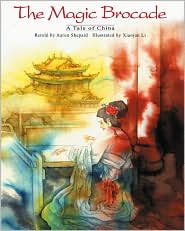
Recommended grades 2-4. Aaron Shepard adapts a Chinese folktale in his picture book, The Magic Brocade (Edustar Press, 2011). In the story, an old widow becomes enchanted by an image of a fairy palace far to the east of her Chinese Village that no mortal has ever traveled to. She spends months weaving her own brocade of the scene, only to have it stolen by the fairies themselves. Her devoted son, Chen, must face certain danger to return the brocade to his mother on her death bed. Chen is a hero on a familiar journey, and he is rewarded for his bravery with a romance of his own. Illustrations by Xiajun Li are done in a marbled watercolor that bleeds and exudes a dream-like quality. It may have been helpful to young readers to have an illustration of the brocade itself to understand the content vocabulary of the book. The author did not include much background information on the origin of the story, which leads readers wanting more. This book could still be used to introduce students to classic elements in folk and fairy tales, including traditional heroes, magical beings, and the similarities in these stories across the world. Recommended, ***
Labels:
***,
China,
elementary,
fairy,
folk tale,
hero quest,
international,
picture book
Monday, October 10, 2011
A Traditional Mother Moose Fairy Tale
Recommended grades 2-5. Author Willy Claflin may be spending too much time out in the woods listening to Moose ramble, but I suppose they can offer entertaining tidbits. In the fractured fairy tale Rapunzel and the Seven Dwarfs (August House, 2011), Claflin "translates" a classic "Mother Moose" tale as told to him by Maynard Moose. This silly amalgamation of fairy tales includes unruly long hair, "eight or nine" seven dwarfs, a wicked witch, an obese prince, and of course, a noble white moose. Claflin apologizes for his difficulty translating from the original moose language-- apparently they use words differently. To mediate the language barrier, Claflin includes a glossary of Moose words, marked in the text with tiny hoof prints. Additionally, the book includes an audio recording on CD of Maynard reading the book for himself. Maynard sounds a bit like a Rick Moranis sketch, but it is a nice addition to the playful world Claflin has created. With Claflin's non-standard use of both grammar and language, this book could be used to introduce young readers to the idea of dialect. James Stinson's angular and cartoony illustrations have an air of computer animation. The color pallet he uses, deep greens and browns, reflect the mysterious fairy tale elements of the dwarves' forrest. Readers will have to be familiar with the original stories, but if they are they will surely take devious pleasure in the liberty Maynard Moose takes with the classics. Recommended, ***
Labels:
***,
elementary,
fairy tale,
moose,
picture book,
Rapunzel,
silly,
Snow White
For the Love of Music
Sunday, October 9, 2011
A River of Words
Recommended Grades 3-5. Jen Bryant narrates the biography of poet William Carlos Williams in her picture book A River of Words (Eerdman's Books, 2008). The reader follows young William as he explores the scenic country in his childhood home of Rutherford, New Jersey, goes to medical school in Pennsylvania with famous friends Ezra Pound, Hilda Doolittle, and Charles Demuth, and opens a his own office back in Rutherford. All the while, Williams shapes the world and words around him into poetry. The illustrations by Melissa Sweet are a high point of the book. Sweet draws simple figures primarily in earth tones-- rough sketches so that you can still see her pencil line. Each illustration is worked into a collage style that includes books from Williams' school days, torn pages from his notebooks with his most famous poems scribbled in different drafts and other artifacts from his developing life. The pictures themselves show the compulsion of Williams' poetical outbursts- that although he was the "busiest man in the county" with his medical practice he could not quiet his mind against the poetic phrases coming in. The illustrations also demonstrate how Williams broke out of the standard rules of poetry to produce his own free form style that has influenced generations of poets after him. Both the author and illustrator express their deep love for Williams, and confess that they are members of those influenced by his work. A River of Words is a Caldecott Honor Book for good reason. The illustrations will inspire young readers and have the potential to inspire future artistic endeavors, just as William Carlos Williams was the inspiration for this book. Highly Recommended, *****
Friday, September 23, 2011
The Last Brother
Grades 3-6 The Tales of Young Americans Series seeks to empower and engage young readers by demonstrating how children have been crucial actors in American history. Trinka Hakes Noble does just this in her contribution to the series, The Last Brother: A Civil War Tale (Sleeping Bear Press, 2006). Our young hero is Gabe, an eleven-year old bugler for the Union Army in Gettysburg on the infamous days of July 1-4, 1863. He has already lost two brothers to the war effort, and fears for his brother Davy who is fighting in his regiment. Noble's writing, along with the heroic illustrations painted by Robert Papp, empathetically captures an authentic feeling character in an incredible situation. Papp paints much in the style of Caspar David Friedrich's romantic paintings, using realistic figures and majestic backgrounds. Following the mission of the series, Gabe is able to play a significant, though realistic role in a monumental moment in American history. Gabe's story is both believable and personal. Noble also effectively captures the gray areas in the "Brother vs. Brother" mantra of the Civil War. Overall, an empathetic and captivating piece of illustrated historical fiction. Recommended, ***1/2
Thursday, September 22, 2011
The Big Box
Grades 1-4 Toni Morrison and son, Slade Morrison, bring us a moralistic rhyming children's book with The Big Box (Hyperion, 1999). The joke is on the adults, however, as they are to learn the ultimate lesson. The story opens with three kids living in a joyful, adult-free world filled with things that kids love-- ice cream, bean-bag chairs, bunk beds, and swing sets, all inside one room (a big brown box)! Adults are only allowed once a week, and when they come, they bring wonderful presents. Within pages we discover that this wonder-room isn't quite what it seems. Our three heroes have been placed there by adults who love them because they have proven that they can't "handle their freedom." The angular, water-colored illustrations by Giselle Potter follow the children as they break rules at school, at home, and in the greater world. The adults in their lives, fearing they will not be equipped for life in the adult world impose limited freedom in the big, brown box. Toni and Slade create sympathetic characters that make us question how we treat children for the sake of "their own good." The illustrations are a bit jarring, though they lend to the surreal aspects of the story. Overall a thought-provoking and musical read-aloud.
Recommended, ***
Tuesday, September 20, 2011
Me, Frida
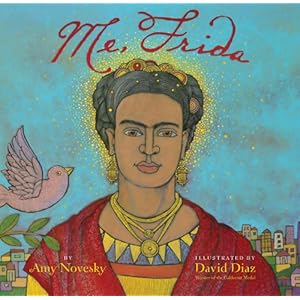
Grades 1-4 In Me, Frida (Abrams, 2010), Amy Novesky tells the tale of Frida Kahlo and her husband, Diego Rivera, on a trip to San Francisco in 1931. Rivera has received a commission to paint one of his infamous labor murals, and Frida feels overlooked and small next to her "elephant" of a husband (large in fame and in stature). Novesky's text is joined with breathtaking artwork by Caldecott Award winner David Diaz. Diaz's artwork nods to both Rivera's and Kahlo's styles, while adding his own take to the sites of San Francisco in dripping paint rich in color. His artwork truly carries the story, as the plot is quite detached from childrens' interests or experiences. The richly colored illustrations and highly stylized San Francisco skyline will be a great building-off point for conversations and projects, though the text alone leaves something to be desired. Though Frida's story may be more interesting to older readers and adults, the illustrations will please everybody.
Additional Selection, **1/2
Subscribe to:
Posts (Atom)